








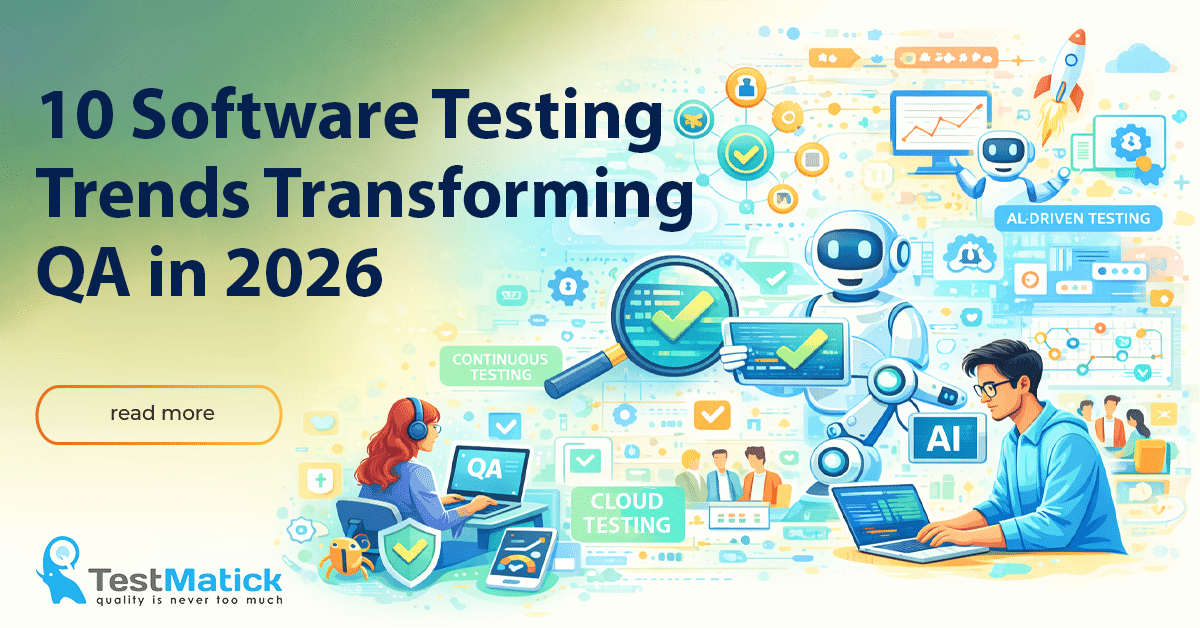
The software testing landscape is evolving at an unprecedented pace. As we navigate through 2026, quality assurance teams face a dual challenge: keeping up with rapid technological advances while ensuring software remains secure, reliable, and user-friendly. The good news? Testing itself is becoming smarter, faster, and more strategic.
From AI-powered autonomous agents to continuous security validation, this year’s trends reflect a fundamental shift in how we approach quality. Here are the top 10 software testing trends shaping 2026 and what they mean for your organization.
1. Autonomous AI Testing Agents
The era of truly autonomous testing has arrived. Unlike traditional test automation that breaks with every UI change, modern AI testing systems use reinforcement learning to design, execute, and maintain tests independently.
These intelligent agents analyze codebases to identify high-risk areas, generate comprehensive test scenarios without manual scripting, and automatically adjust when UI elements change — eliminating the constant maintenance burden that has plagued testing teams for years. Research indicates that AI augmentation is projected to reduce manual testing efforts by up to 45% in 2026.
What this means for your team: QA professionals can shift focus from writing repetitive test scripts to strategic quality decisions and exploratory testing that requires human creativity and insight.
2. Testing AI-Generated Code
As AI coding assistants like GitHub Copilot become mainstream, a new testing specialty has emerged. While these tools accelerate development, the code they produce requires specialized validation. Recent analysis shows that AI-generated code has a significantly higher defect rate than human-written code, with over 70% of developers reporting they routinely need to rewrite or refactor AI outputs before production.
Testing AI-generated code involves security pattern analysis to identify potential vulnerabilities, edge case coverage that the AI might have missed, and complexity analysis to ensure maintainability. Forward-thinking QA teams now trace every AI-generated function back to its originating prompt and require higher test coverage thresholds before code review.
What this means for your team: Develop new review protocols specifically for AI-generated code, combining automated static analysis with rigorous manual inspection.
3. Strategic AI-Powered Quality Assurance
AI has evolved from an execution tool to a strategic partner. Modern AI systems make intelligent decisions about testing priorities based on code changes, production telemetry, and historical patterns. The software testing market, estimated at $57.73 billion in 2026, is being transformed by this strategic shift.
These systems optimize test suites by recommending which tests to run, identifying coverage gaps, scoring deployment risk, and even proposing specific fixes when tests fail. Organizations report a 50% reduction in test execution time while maintaining or improving defect detection rates.
What this means for your team: Invest in AI testing platforms that provide actionable insights, not just automated execution. The goal is intelligence-driven testing that aligns with business outcomes.
4. Continuous Security Testing in DevSecOps
Security is no longer a gate at the end of the pipeline — it’s embedded throughout the entire software development lifecycle. DevSecOps practices integrate automated security testing, vulnerability scans, and compliance checks directly into CI/CD pipelines, catching issues early when they’re cheapest to fix.
With supply-chain vulnerabilities projected to account for 45% of global software security incidents by 2026, continuous security validation has become non-negotiable. Modern DevSecOps incorporates static application security testing (SAST), dynamic application security testing (DAST), software composition analysis (SCA), and runtime monitoring that feeds exposure data back into development feedback loops.
What this means for your team: Security testing can no longer be an afterthought. Embed automated security scans at every stage and prioritize vulnerabilities based on runtime context and exploitability, not just severity scores.
5. Shift-Left and Shift-Right Testing
The boundaries of testing have expanded in both directions. Shift-left testing moves quality assurance earlier into design and development phases, while shift-right extends monitoring and validation into production environments.
This dual approach creates a continuous quality loop: detecting issues early reduces risk and accelerates time to market, while production insights reveal real-world behavior that lab testing cannot replicate. Currently, 40% of testing teams have integrated shift-left security testing into CI/CD pipelines, and this number continues to grow.
What this means for your team: Quality assurance becomes an ongoing conversation, not a milestone. Combine early-stage testing with production monitoring to maintain comprehensive visibility.
6. API-First and Contract Testing
As microservices architectures dominate modern software, API and contract testing have become essential. Testing the foundational layer of application architecture — validating APIs and their contracts before running end-to-end scenarios — reduces integration issues and improves system stability.
The trend toward API-first testing acknowledges that in distributed, modular architectures, the API layer is where most failures originate. By verifying performance, usability, and security at this fundamental level, teams prevent issues from cascading through complex systems.
What this means for your team: Expand test automation beyond UI into comprehensive API testing. Ensure every microservice maintains its interface contracts before integration.
7. Self-Healing Test Automation
Advanced self-healing test automation has matured from basic implementations to sophisticated AI/ML-powered systems. These tools use historical element locator data and patterns of previous changes to adapt test scripts automatically when applications evolve.
When a UI element is renamed or moved, self-healing tests adjust on their own, dramatically reducing maintenance overhead. Organizations using advanced self-healing automation spend less time fixing tests and more time improving their applications, achieving better test coverage across more features, devices, and platforms.
What this means for your team: Adopt testing tools with built-in self-healing capabilities. The reduction in maintenance time translates directly to faster release cycles and improved team morale.
8. Human-in-the-Loop AI Validation
While AI powers much of modern testing, the need for human judgment remains critical — especially when testing AI systems themselves. Binary pass/fail assertions collapse in AI-driven applications where outputs change with context and user history.
By early 2025, 76% of enterprises had implemented explicit human-in-the-loop review processes to catch AI failures like hallucinations, biased outputs, or unsafe guidance. Knowledge workers now spend an average of 4.3 hours per week reviewing and fact-checking AI outputs. Mature teams operationalize this through trained reviewers, calibrated scoring rubrics, and clear escalation paths.
What this means for your team: Formalize human review processes with clear criteria and trained evaluators. AI can surface anomalies, but it cannot reliably judge intent, context, or downstream harm.
9. Cloud-Based Testing Infrastructure
Cloud-based testing has evolved from emerging trend to standard practice. Testing platforms leverage cloud capabilities to provide unprecedented scalability, accessibility, and collaboration features. Need to run 10,000 parallel tests before a major release? Cloud infrastructure makes it possible.
Modern cloud testing enables teams to scale infrastructure dynamically based on demand, access testing environments from anywhere, collaborate in real-time across distributed teams, and reduce infrastructure costs by paying only for what they use.
What this means for your team: Transition to cloud-based testing platforms that offer flexibility and scale. The days of maintaining expensive on-premises test environments are numbered.
10. IoT and Edge Computing Testing
As Internet of Things devices and edge computing workloads proliferate, new testing methodologies are required. IoT testing validates that connected devices operate smoothly, safely, and reliably across networks and platforms, in real-world conditions that lab testing cannot replicate.
This includes testing device interoperability, network connectivity resilience, data flow optimization, security vulnerabilities, and performance under load. IoT testing has become essential for industries deploying smart home devices, industrial IoT systems, healthcare monitors, and autonomous vehicles.
What this means for your team: Develop expertise in testing cyber-physical systems and devices operating in unpredictable real-world environments. Simulation alone is insufficient — real-world testing scenarios are critical.
Preparing Your Team for the Future
Understanding these trends is valuable, but implementation requires strategy. Here’s how to move forward:
Start with quick wins: Identify areas where AI-powered testing or self-healing automation can provide immediate value. Small successes build momentum and executive support.
Align with business goals: Every testing initiative should connect to business outcomes—faster releases, reduced risk, improved customer satisfaction, or compliance requirements.
Invest in training: The skills gap is real. Ensure your team develops expertise in AI testing tools, automation frameworks, cloud testing, and security testing practices.
Foster collaboration: Modern testing requires breaking down silos between development, security, and operations. Create cross-functional teams with shared responsibility for quality.
Measure what matters: Track metrics that demonstrate testing effectiveness — defect escape rates, time to detection, test coverage, and deployment frequency—not just the number of test cases executed.
The Bottom Line
The software testing trends of 2026 represent a fundamental transformation. Testing is becoming more predictive, autonomous, and intelligence-driven. Security is embedded throughout the development lifecycle. Quality assurance extends from design through production monitoring.
Organizations that embrace these trends will release higher-quality software faster, with less risk and greater confidence. Those that resist change will find themselves struggling to keep pace with competitors who’ve modernized their QA practices.
The future of testing isn’t about working harder—it’s about working smarter by leveraging AI, automation, and strategic insights to deliver exceptional software quality. The tools and methodologies exist today. The question is: will your organization seize the opportunity?
As the testing landscape continues to evolve, one thing remains constant: quality cannot be an afterthought. By staying informed about emerging trends and investing in the right tools, training, and practices, your QA team can become a strategic driver of business success in 2026 and beyond.



0 Comments