








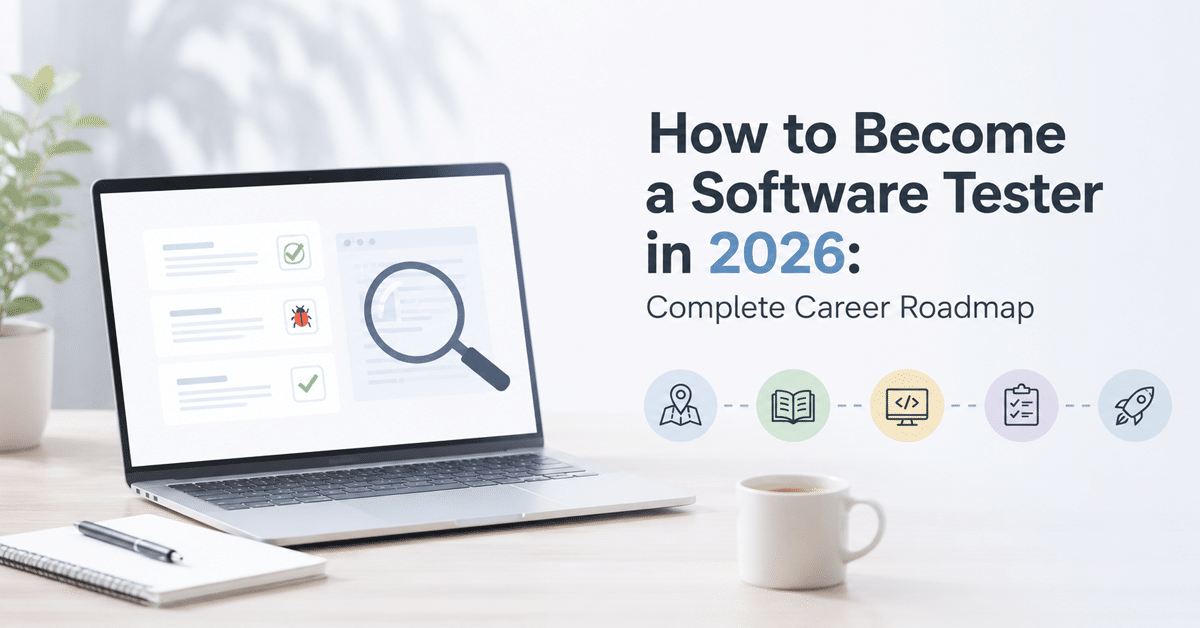
Skills, certifications, tools, salaries, and the path from zero to senior QA engineer
Software testing is one of the most accessible technical careers to enter — and one of the most underestimated in terms of career ceiling.
The entry point is lower than software development: you don’t need a computer science degree, and you don’t need years of coding experience to get your first QA role. But the ceiling is high: senior QA engineers, QA architects, and engineering managers with QA backgrounds earn well over $100,000 at companies of every size.
In 2026, QA is also evolving faster than it has in a decade. Automation is expected at every level. AI tools are changing how tests are written. DevOps practices mean QA engineers work closer to the development pipeline than ever before. Getting into the field now means entering a discipline that’s growing in scope and value, not shrinking.
This roadmap covers everything you need: the skills that matter, the certifications worth pursuing, the tools employers actually use, salary ranges by experience level, and a realistic path from your first QA job to wherever you want to take the career.
Skills needed: technical and soft
Technical skills
The technical skills required for QA have expanded significantly over the past five years. Manual testing fluency remains important at the junior level, but automation skills are increasingly expected even for entry-level roles at modern tech companies.
Core technical skills for a QA career in 2026:
- Understanding of software development lifecycle: how software is planned, built, tested, and deployed. You don’t need to be a developer, but you need to understand how the process works to be effective within it.
- Manual testing fundamentals: test case design, exploratory testing, bug reporting, test documentation. These remain the foundation even as automation grows.
- API testing: understanding REST and GraphQL APIs, testing with tools like Postman, interpreting HTTP responses. Modern applications are API-driven, and QA engineers who can’t test APIs are limited in what they can cover.
- Basic programming or scripting: Python, JavaScript, or Java at a functional level. You don’t need to build applications, but you need to read code, write test scripts, and understand what developers are building.
- Test automation basics: understanding how automation frameworks work, writing and maintaining automated tests, recognizing when automation is and isn’t appropriate.
- SQL basics: the ability to query databases to verify data integrity and investigate bugs. Most QA engineers need SQL regularly.
- Version control: Git fundamentals — committing, branching, pull requests. Test code lives in the same repositories as application code.
- CI/CD awareness: understanding how automated pipelines work and how tests fit into them. Increasingly expected even at junior levels.
Soft skills
QA requires a specific mindset that’s distinct from development. The best QA engineers share certain characteristics that aren’t directly technical:
- Analytical thinking: the ability to break down complex systems into testable components, identify edge cases, and think about failure scenarios systematically.
- Attention to detail: catching the bug that everyone else missed because it only occurs under a specific combination of conditions.
- Communication: writing bug reports that developers can act on without asking follow-up questions. Explaining complex technical issues to non-technical stakeholders. Advocating for quality in conversations where it’s not the default priority.
- Curiosity: the best QA engineers are genuinely curious about how things break. They don’t just execute test cases — they explore systems looking for unexpected behavior.
- Collaboration: QA sits at the intersection of development, product, and operations. Effective QA engineers work well across all three.
- Adaptability: requirements change, priorities shift, and tools evolve. QA requires constant learning and adjustment.
Certifications worth pursuing
QA certifications are not universally required, but they demonstrate foundational knowledge and can differentiate your resume — particularly at the junior level when you don’t have extensive work experience.
ISTQB — International Software Testing Qualifications Board
ISTQB is the most widely recognized QA certification globally. The Foundation Level (CTFL) covers core testing concepts: test design, test management, test tools, and the software development lifecycle as it relates to testing.
Who should pursue it: anyone entering QA without prior experience. It provides a structured vocabulary and framework that makes you easier to onboard and more credible in interviews. The exam is accessible — a few weeks of study with the official syllabus is sufficient for most candidates.
Beyond Foundation: ISTQB offers Advanced and Expert levels in specializations including Test Automation, Test Management, and Agile Testing. These are worth pursuing after 2-3 years of experience when you’ve identified your specialization direction.
CSTE — Certified Software Test Engineer
CSTE is offered by the Quality Assurance Institute (QAI) and is more widely recognized in the US than internationally. It requires 2+ years of experience in software testing or quality assurance, making it a certification to pursue after your first role rather than before it.
CSTE covers both technical testing skills and quality management practices. It’s particularly valued in enterprise environments and regulated industries (healthcare, finance, government) where formal quality management frameworks are common.
Vendor-specific certifications
Several tool vendors offer certifications that can be valuable depending on your specialization:
- Selenium certification (various providers) — relevant for UI automation roles
- AWS, Azure, or GCP certifications — relevant for QA engineers working in cloud environments
- Postman certification — relevant for API testing specialization
- Agile and Scrum certifications (CSM, PSM) — valuable for QA engineers working in Agile teams
Vendor certifications are most valuable when they align with the tools used by your target employers. Check job listings for the roles you want and see which tools appear most frequently.
Learning path: Manual → Automation → DevOps
A realistic career progression for someone entering QA in 2026 follows a progression from manual foundations through automation fluency to DevOps integration. This isn’t a rigid sequence — many paths exist — but it reflects the skill accumulation that makes each stage possible.
Stage 1: Manual testing foundations (0-12 months)
Before automating tests, you need to understand what you’re automating and why. The manual testing phase builds the foundational skills that make everything else possible.
Focus areas:
- Test case design techniques: equivalence partitioning, boundary value analysis, decision tables, exploratory testing
- Bug reporting: writing clear, reproducible bug reports with steps to reproduce, expected behavior, actual behavior, environment details
- Test documentation: test plans, test cases, test reports
- Agile testing practices: how QA fits into sprints, how to work with user stories and acceptance criteria
- API testing with Postman: understand request/response structures, test APIs manually before automating them
- SQL fundamentals: write basic queries to verify data in databases
Resources: ISTQB Foundation Level syllabus, The Art of Software Testing (Myers), online courses on Udemy or Coursera covering software testing fundamentals.
Stage 2: Test automation (1-3 years)
Once you understand what to test, automation makes testing faster, more consistent, and more comprehensive. This stage focuses on building automation skills on top of your manual testing foundation.
Focus areas:
- Programming fundamentals: Python or JavaScript to a functional level. Pick one and get comfortable with loops, functions, classes, and error handling.
- Selenium WebDriver: the foundational UI automation tool. Even if you end up using Playwright or Cypress, understanding Selenium’s architecture helps with all UI automation.
- Cypress or Playwright: modern alternatives to Selenium with better developer experience. Playwright is increasingly the default recommendation for new projects.
- API test automation: RestAssured (Java) or requests + pytest (Python) for automated API testing
- Test frameworks: pytest, JUnit, TestNG — how to structure automated test suites
- Git and version control: committing test code, working with branches, code review basics
The practical project: build an automated test suite for a real application. Many QA candidates use open-source e-commerce or to-do applications as practice targets. A GitHub repository with working automated tests is stronger evidence of skill than any certification.
Stage 3: DevOps integration (3+ years)
Modern QA engineers don’t just write tests — they integrate testing into the development pipeline and contribute to the engineering culture around quality. This stage is about expanding from test execution to test strategy and infrastructure.
Focus areas:
- CI/CD pipelines: configuring GitHub Actions, GitLab CI, or Jenkins to run tests automatically. Understanding pipeline stages and quality gates.
- Docker and containerization: running tests in containers, understanding how test environments are configured
- Performance testing: k6 or JMeter for load testing, understanding performance metrics and thresholds
- Security testing basics: OWASP Top 10, basic penetration testing concepts, integrating security scans into pipelines
- Observability: understanding logs, metrics, and traces. How monitoring informs testing strategy.
- Test architecture: designing test suites that scale, making decisions about what to automate and what to keep manual
Tools to master
The QA tool landscape is large. Here’s a prioritized guide to what actually matters in the job market:
| Category | Tools to learn | Priority |
| Test management | Jira, TestRail, Zephyr | High — used everywhere |
| API testing | Postman, RestAssured, k6 | High — critical for modern apps |
| UI automation | Selenium, Cypress, Playwright | High — core automation skill |
| Mobile testing | Appium, XCUITest, Espresso | Medium — valuable specialization |
| Performance testing | JMeter, k6, Gatling | Medium — growing demand |
| CI/CD | GitHub Actions, Jenkins, GitLab CI | Medium — increasingly expected |
| Version control | Git, GitHub | High — non-negotiable |
Don’t try to learn everything at once. At the junior level: Jira, Postman, and one UI automation framework (Cypress or Playwright) covers most job requirements. Add Git, SQL, and CI/CD basics and you’re competitive for most entry-level roles. Specialize from there based on where you want to focus.
Salary ranges by experience
QA salaries in the US have grown significantly over the past five years as automation skills became standard expectations. Here’s the current landscape:
| Level | Experience | US Salary Range | Key skills at this level |
| Junior QA Engineer | 0-2 years | $50,000 – $70,000 | Manual testing, basic Selenium, bug reporting |
| QA Engineer | 2-4 years | $70,000 – $90,000 | Automation, API testing, CI/CD basics |
| Senior QA Engineer | 4-7 years | $90,000 – $110,000 | Test architecture, mentoring, performance testing |
| QA Lead / Manager | 7+ years | $110,000 – $130,000 | Team leadership, strategy, stakeholder management |
| QA Architect / Director | 10+ years | $130,000 – $160,000+ | Enterprise test strategy, tooling decisions, org design |
These ranges reflect US market data for 2026. Significant variables: company size (FAANG and growth-stage startups pay more than enterprise), location (San Francisco and New York pay 20-40% above the national average), specialization (automation engineers and security testers earn more than manual-only testers), and industry (fintech, healthcare, and enterprise SaaS pay more than consumer apps).
The salary trajectory from junior to senior is steeper in QA than many people expect. A junior QA engineer who builds strong automation skills and specializes in a high-demand area (performance testing, security testing, mobile) can reach the $90,000-$110,000 range in 4-5 years.
How to get your first QA job
The first QA job is the hardest to get — not because QA is difficult to learn, but because most employers want experience even for entry-level roles. Breaking in requires a combination of demonstrated skill, strategic positioning, and persistence.
Build a portfolio before you apply
A GitHub repository with working automated tests is the most effective way to demonstrate skill before you have professional experience. Target practice:
- Find an open-source web application (OpenCart, SauceDemo, or similar) and write a test suite for it
- Include functional tests, API tests, and basic CI configuration
- Write clear README documentation explaining your test strategy and what you tested
- Keep it maintained — interviewers check when the last commit was
This portfolio demonstrates the same skills an employer would see in your first month on the job, without requiring a reference from a company that hasn’t hired you yet.
Target the right opportunities
Some paths into QA are easier than others for career changers and new graduates:
- QA roles at small and mid-size tech companies: less competitive than FAANG, more likely to hire and train entry-level candidates
- Manual QA roles with automation growth potential: starting manual and building automation skills internally is a common and successful path
- QA roles at outsourcing and consulting companies: firms like TestMatick hire QA engineers at multiple levels and provide exposure to diverse projects and industries
- Internal transfers: if you’re already at a tech company in a non-technical role, internal transfers to QA can bypass the entry-level hiring competition
The interview process
QA interviews typically include:
- Technical screen: bug reports, test case design, basic SQL queries, manual testing scenarios
- Take-home test: write test cases for a given feature or application
- Automation exercise: write automated tests for a simple application or API
- Behavioral interview: how you’ve handled conflicts, found difficult bugs, worked with developers
Prepare for the take-home exercise specifically — it’s where most candidates struggle or distinguish themselves. Practice writing test cases for real applications, focusing on completeness, edge case coverage, and clarity.
Career progression paths
QA careers branch in several directions after the senior engineer level. Understanding the options helps you make intentional choices about skill development.
Individual contributor path
- Senior QA Engineer → Staff QA Engineer → Principal QA Engineer → QA Architect
This path stays technical and deepens expertise. QA architects design testing infrastructure for entire organizations, make tooling decisions, and define quality standards. Compensation at the architect level is comparable to senior software engineers.
Management path
- Senior QA Engineer → QA Lead → QA Manager → Director of QA → VP of Engineering
This path moves toward people management and organizational strategy. QA managers hire, mentor, and develop QA teams. Directors define quality strategy across multiple teams or product lines. This path requires strong communication and leadership skills alongside technical credibility.
Specialization paths
- Performance engineering: deep expertise in load testing, capacity planning, and performance optimization
- Security testing: penetration testing, application security assessment, compliance testing
- Automation engineering: building and maintaining test infrastructure at scale
- Developer Experience (DevEx): working on CI/CD pipelines, developer tooling, and engineering productivity
Specialization typically comes after 3-5 years as a generalist QA engineer. The specializations with the highest market demand and compensation in 2026: security testing, performance engineering, and automation architecture.
A note on AI and the future of QA
The honest question many people entering QA ask in 2026: will AI replace software testers?
The short answer: no, not in any near-term timeframe. The longer answer: AI is changing what QA engineers spend their time on, just as it’s changing software development. AI tools generate test scaffolding, catch common vulnerability patterns, and handle visual regression comparison. They’re good at pattern recognition and repetitive work.
What they don’t do: understand business requirements, identify which edge cases matter for a specific domain, make judgment calls about risk, or find the bugs that nobody thought to look for. These remain human skills, and they remain the core of effective QA.
QA engineers who learn to use AI tools effectively — as productivity multipliers rather than replacements for expertise — will be more valuable, not less. The skill floor for QA is rising; the ceiling is rising faster.
Looking to start or grow your QA career?
TestMatick is a New York-based software testing company with 150+ QA specialists working across diverse industries and technologies. We work with QA engineers at all experience levels — from first roles to senior positions.
If you’re building your career in software testing, explore opportunities at TestMatick. We offer exposure to varied projects, mentorship from experienced QA engineers, and the chance to build skills across the full testing spectrum.
-> View Open Positions — testmatick.com/careers
-> Contact TestMatick — testmatick.com


0 Comments