








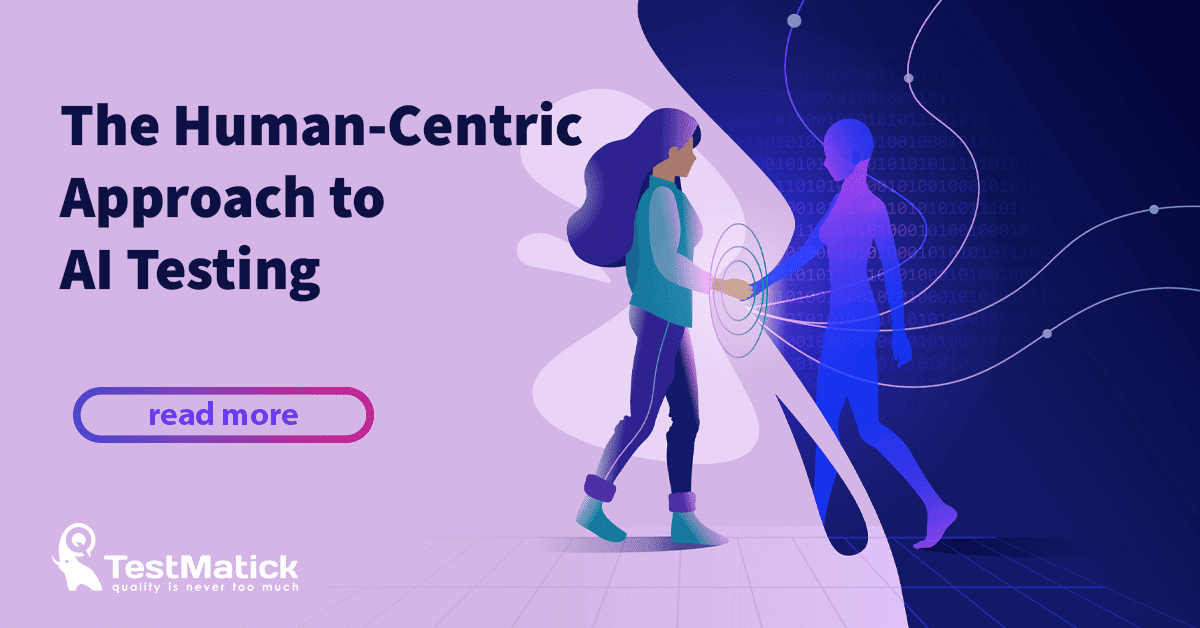
Artificial Intelligence (AI) is transforming industries, automating decisions, and redefining how humans interact with technology. From personalized recommendations on our phones to medical diagnosis support and autonomous vehicles, AI systems are increasingly influencing human lives in direct and meaningful ways.
This rapid adoption has raised a critical question: How do we test AI not just as software, but as technology that deeply impacts people?
Traditional testing focuses on functionality, performance, and code correctness. While these remain important, AI testing must also address broader concerns: fairness, transparency, usability, and trust. In other words, testing AI goes beyond code – it must adopt a human-centric approach.
Why Human-Centric Testing Matters in AI
AI doesn’t just execute instructions – it learns, adapts, and makes predictions that affect individuals and communities. Unlike traditional software, its outcomes are often probabilistic rather than deterministic, meaning two identical inputs may not always lead to the same result.
This creates unique risks:
- An unfair loan approval model may discriminate against certain applicants.
- A biased recruitment tool may disadvantage underrepresented groups.
- A healthcare diagnostic system could miss rare cases if not tested with diverse data.
In all these cases, the code itself might be flawless – but the system still fails humans. That’s why QA teams must widen their scope to include social, ethical, and usability dimensions of testing.
Key Dimensions of Human-Centric AI Testing
A human-focused testing strategy goes beyond accuracy metrics and explores how real users experience, interpret, and are impacted by AI systems.
1. Fairness and Bias Testing
AI systems are only as good as the data they’re trained on. If datasets contain historical biases, the AI may reproduce or even amplify them. Testers must evaluate models across different demographics, geographies, and contexts to detect bias.
Instead of asking only, “Does the model achieve 95% accuracy?”, we must also ask, “Is accuracy evenly distributed across groups?” Fairness testing requires building test datasets that include diverse user profiles and edge cases to ensure equitable outcomes.
2. Transparency and Explainability
One of the biggest challenges in AI adoption is the “black box” problem – users often don’t understand how AI reached a particular decision. A human-centric approach to testing includes verifying that the system provides explainable outputs where required.
For example, in healthcare or finance, it’s not enough for the system to say “Approved” or “Declined.” It should also offer a clear explanation, such as “Decision influenced by repayment history and income stability.” Testers must validate that explanations are accurate, user-friendly, and consistent with the actual decision logic.
3. Usability and Human-AI Interaction
Even if an AI system is technically accurate, it may fail if users find it confusing, intimidating, or frustrating. Usability testing ensures that human-AI interactions feel natural, intuitive, and trustworthy.
For instance, conversational AI like chatbots must be tested not only for response accuracy but also for tone, empathy, and clarity. A medical chatbot giving cold or overly technical responses can alienate patients – even if the information is factually correct.
4. Safety and Reliability in Real Contexts
AI often operates in dynamic, unpredictable environments. Testing must therefore include real-world conditions where errors could have serious consequences. Autonomous vehicles, for example, must be tested in varied weather, lighting, and traffic conditions – not just simulated ones.
Reliability also means ensuring that AI systems degrade gracefully. If a model fails, does the system alert the user, fall back to a safe mode, or simply break? Human-centric testing emphasizes fail-safe behavior that prioritizes user safety.
5. Ethical and Regulatory Compliance
In sectors like healthcare, finance, or government, ethical concerns are tightly linked with regulatory requirements. Human-centric testing includes validating compliance with laws and standards, such as GDPR (data protection), HIPAA (healthcare privacy), or ISO guidelines for AI ethics.
Beyond compliance, testers play a role in raising red flags when AI systems might cause harm, even if technically legal. QA becomes not just a gatekeeper for quality but a guardian of user trust.
Shifting the Role of Testers
Adopting a human-centric approach requires a mindset shift for QA professionals. Testers are no longer just verifying functionality; they are becoming:
- Advocates for end-users, ensuring AI benefits people fairly and safely.
- Ethics checkers, raising concerns about bias, unfairness, or harmful implications.
- Interpreters of AI, helping bridge the gap between complex algorithms and human understanding.
This broader role means testers need to collaborate more closely with data scientists, UX designers, ethicists, and domain experts. Testing AI becomes a multidisciplinary activity where technical validation and human impact are inseparable.
Best Practices for Human-Centric AI Testing
While each AI system is unique, several best practices help guide a people-first testing approach:
- Design inclusive test datasets that reflect the diversity of real users, not just majority groups.
- Validate explainability – ensure outputs are understandable by non-experts.
- Simulate real-world scenarios with environmental variability, stress conditions, and adversarial inputs.
- Include human feedback loops – involve actual users in testing phases to capture perceptions and trust levels.
- Monitor post-deployment behavior – AI may evolve over time, so continuous testing and user feedback are critical.
Conclusion
Testing AI is no longer just about validating algorithms – it’s about ensuring these systems serve humans responsibly. By adopting a human-centric approach, QA teams expand their mission from preventing software bugs to safeguarding fairness, trust, and user well-being.
AI systems that are tested with people in mind are more likely to be accepted, trusted, and impactful. For businesses, this means higher adoption rates, stronger reputations, and reduced risks of ethical or legal backlash. For society, it means technology that truly improves lives. At the end of the day, AI may run on code, but its success depends on people. And that’s why human-centric testing isn’t optional – it’s essential.



0 Comments